

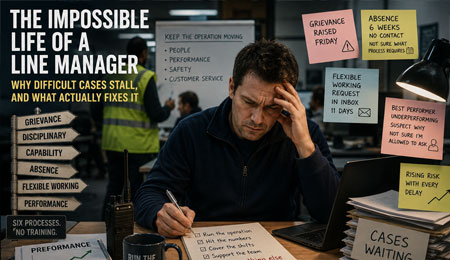
Most organisations believe they have a manager capability problem. What they usually have is a process problem that lands on managers and then gets described as their failing.
A week in the life
Run the depot, the ward, or the operation that has to get goods or passengers where they need to be. Hit the numbers. Cover the shifts when three people call in sick on the same morning.
Now add the rest of it. A grievance was raised against one of your team on Friday. Someone has been off for six weeks and, as far as you can tell, nobody has called them — and you are not certain what the process actually requires you to do. A flexible working request has been sitting in your inbox for eleven days; you think it may be unreasonable but you are not sure how to say so, and you do not know what the statutory timescale is. One of your best people has started underperforming. You suspect you know why. You are not sure you are allowed to ask.
None of that feels like the job. All of it is the responsibility. And all of it drains the person carrying it, along with the operational numbers they are held to.
Six processes, no training
The average line manager in a large employer is expected to handle grievance, disciplinary, capability, absence, flexible working and performance matters. Six distinct processes. Each with its own timescales, its own evidentiary standard, its own escalation route, and its own way of going wrong.
Almost none of them have had specialist training in any of it.
The policies exist. They are PDFs on an intranet that is difficult to navigate, and each one takes the best part of an hour to read for the first time — time a manager running a live operation does not have at the moment a case lands.
So where does the process actually live? Usually with an HR business partner who covers four sites and is in a meeting. Or with a central HR service that opens a ticket and comes back to say there is a protected characteristic here, so this will need to be a capability case. Or with occupational health, whose report arrives weeks later, restates what the employee said, answers none of the questions the manager actually asked, and offers nothing that can be acted on.
Meanwhile every one of those cases carries a rising tribunal risk. It rises with every delay. It rises with every decision to let this one go and do better next time.
The part nobody accounts for
Here is what makes the line manager’s position genuinely different from everyone else’s in the chain, and it is the thing that almost never gets said.
They are the only person who has to look that employee in the eye tomorrow morning and run a shift alongside them.
HR advises from a distance. Occupational health writes a report and moves on. Leadership sees a number in a board pack. The line manager investigates a grievance against someone they will be working next to for the rest of the week, and challenges the attendance of someone whose cooperation they need to cover Saturday.
That is a materially harder job than the org chart suggests, and no part of the process is designed around it.
So they do the rational thing
Faced with a quasi-legal process they have never been trained in, no clear steps, support that does not help, and a working relationship to protect, most managers do the only sensible thing available to them. They do nothing. Or they deflect the case into another policy where it can sit without resolution.
It is worth being precise about what that costs, because it is measurable.
One large retailer told us their target for cases needing an external ER advisor was 5% of caseload. The actual figure had crept to three times that. Not because the cases were genuinely more complex, but because managers had stopped attempting them.
Another organisation described case documentation as constantly protracted. When we looked at why, assembling the evidence for a single complex case was taking five to ten days of manual work — not because the case demanded it, but because nothing was structured well enough to do it faster.
We have heard attendance cases described as dragging on for months before being quietly withdrawn, with a note to do better next time. And flexible working requests — not a complex case type by any reasonable standard — turning into tribunal claims.
Line managers at one large client all said the same thing, unprompted: advice from central HR does not help them. It sits on the fence, defaults to risk-averse, and is more interested in closing the ticket than working a genuinely difficult case through alongside the person who has to manage it.
They care. They are guessing.
Then the organisation sits in a meeting and concludes that managers do not care, do not have the skill set, or are not ready to handle this kind of thing.
They care. They are guessing. There is a difference, and it is the organisation’s failing rather than theirs.
The fix is cheaper than the problem
This is one of the least expensive problems a large employer has available to fix.
It is not more policy. It is not another training day that nobody remembers by the following month. It is the steps, in front of the manager, at the moment the case lands. What to do. By when. What to write down. What happens next. Clear, actionable advice from HR. An unambiguous report from occupational health that answers the questions asked. Policy applied consistently across every site rather than interpreted locally.
Give a manager that and they do not need to become an HR expert. They need ten minutes and a clear instruction.
The results are measurable. A comparable FTSE250 operator reduced average days lost by 37% over six years, worth approximately £4m a year — not by adding HR headcount, but by giving managers a guided process and giving leadership visibility of whether it was being followed. A large acute NHS trust running a targeted musculoskeletal programme saw returns to work 55% faster and eleven days off the average case duration, delivering over £1m of savings in six months. In that case the clinical pathway was not new. What changed was that the information reached someone early enough to act on.
It works both ways
None of this is an argument that HR and occupational health are the villains.
They are stretched too, and they say so: overworked, too many inappropriate referrals, managers doing the wrong thing, too many cases. Everyone in the chain is carrying more than the process was designed for.
There is one exception worth naming. If you are an outsourced provider paid per case or per referral, reducing volume was never the problem you were hired to solve. That is not an accusation of bad faith — it is simply what the contract rewards, and it is worth understanding when you are wondering why caseloads never seem to fall.
Ask them
Managers run your organisation. How they are coping is a separate question, and most organisations have not asked it.
So ask one of them what happened the last time a difficult case landed on their desk. Then ask what help they actually got.
The answer will tell you more about your employee relations risk than any dashboard will.
