

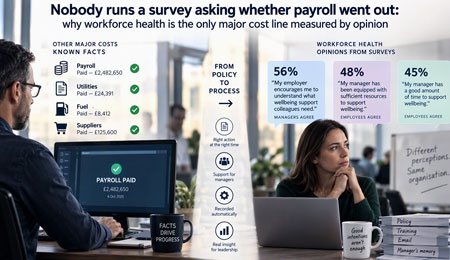
Every other significant cost in a business produces facts. Workforce health produces opinions, collected by survey, because nothing in most organisations is capable of producing the fact. New research published this month shows what that looks like from both sides of the same organisation.
Facts and opinions
Nobody runs a survey asking whether payroll went out. Nobody asks the board whether they believe the fuel bill was paid. Those things are known, to the penny, on the day, because the systems that produce them cannot be run on memory or from a written policy. The question never needs to be asked.
Now consider how workforce health gets measured.
Working to Wellbeing published research on 6 October, surveying 2,000 UK working adults including around 1,000 line managers. Managers were asked whether they agreed their employer encourages them to understand what wellbeing support individual colleagues need: 56% agreed, 19% disagreed, and a quarter sat neutral. Asked whether their organisation has implemented a strong return-to-work plan, 54% agreed and 17% disagreed.
Then the same questions were put to employees. 48% agreed their line manager had been equipped with sufficient resources to support wellbeing, with 22% disagreeing. 45% agreed their manager had a good amount of time to do it, with 23% disagreeing.
Two groups inside the same organisations describing two different realities. And a quarter of managers who could not say either way.
The percentages are interesting. What they rest on is more interesting. Every one of those findings is an agree-or-disagree statement, because a survey was the only instrument available. There is no system anywhere in most organisations that could have answered the question directly.
That is the gap. Not policy. Not intent. Not managers who do not care.
A policy is a document, not a process
Your organisation has a policy. Almost every large employer does, and most leadership teams believe that having one means the job is being done.
But a policy tells a manager what should happen. It does not tell them what to do on Tuesday morning when someone has been off for nine days and nobody has called. It does not tell them what support the organisation actually has available for an employee returning with back pain to a busy Monday shift — or whether that support can be accessed this week or in six weeks.
So delivering the policy falls to the manager. In practice that means remembering. Remembering that a trigger point was reached. Remembering what the options are and which apply here. Remembering what was agreed at the last meeting. Remembering to record it somewhere that will still exist, and still be findable, in six months when it matters.
That is not a process. That is a person carrying a process in their head while running an operation.
And the research reflects it precisely. Under half of employees think their manager has the time. Mayfield’s Keep Britain Working review specified that line managers need the “confidence, time and support to act early”. On two of those three, fewer than half of the people on the receiving end believe it is there.
This is risk aversion, not indifference
The Keep Britain Working final report reached the same conclusion from a different direction. It found that fear runs through this whole area — employees fearing that disclosing a condition will damage their prospects, and managers fearing that raising a health issue will cause offence, trigger a grievance, or escalate into a tribunal. It reported employees off sick for months with little or no contact from their employer, and was explicit that this is not because employers or managers are uninterested. It is risk aversion.
Risk aversion is a rational response to being asked to act without a process. If you do not know what you are allowed to say, what the organisation can offer, or whether your decision will be defensible in nine months, the safest available action is no action. Every manager who has ever been told “check with HR” and then waited four days for an answer has learned that lesson.
The organisations that fix this do not fix it by issuing a better policy or running more training. They fix it by removing the judgement calls the manager was never equipped to make.
“Systemise” does not mean more admin
This is where most leadership teams stop listening, because the word arrives attached to a mental image of managers filling in more fields.
The admin already exists. It is being done today, by the same managers, in worse conditions. It is spread across a notebook, a saved email, a policy PDF nobody can navigate, a conversation nobody wrote up, and one person’s memory. It takes longer, it produces nothing anyone else can see, and it disappears entirely when that manager moves on.
Systemising end to end means the policy stops being a document and becomes a sequence: the right action surfaced at the right moment, with the available options attached, recorded as it happens as a by-product of doing it rather than as a separate task afterwards, and visible to leadership whether it happened or not.
The output is the part that changes the conversation. Do this and you no longer have a view on whether cases are being managed. You have the fact — every step of every case, for every employee, for every manager, continuously. Not once a year, following a survey.
Why this is about to matter more
Three things are converging.
Statutory sick pay has been payable from the first day of absence since 6 April 2026, with the lower earnings limit removed, at the lower of £123.25 a week or 80% of average weekly earnings. Short, frequent absences that previously cost nothing now carry a cost from day one — and those are precisely the absences most likely to be recorded inconsistently or not at all.
The government’s September update to Keep Britain Working describes intelligence as the engine of the workplace health system it intends to build, with an employer data project beginning this autumn across large and smaller employers in both the private and public sectors. Its draft standard puts weight on equipping line managers to hold conversations about work rather than diagnosis — which is a process question, not a training question.
And the national picture is not improving. ONS figures published in May put UK sickness absence at 2.0% of working hours in 2025, 148.8 million working days lost, an average of 4.4 days per worker, essentially unchanged on the year before.
Organisations that can produce their own numbers will be able to engage with all of this. Organisations that can only produce opinions will be surveyed about it.
The question to ask
If you want to know where your organisation sits, there is a single test, and it does not require a consultant.
Pick one employee who has been off for more than four weeks. Ask who spoke to them, when, what was agreed, what support was offered, and whether any of that is recorded anywhere a second person could find it.
If the answer involves phoning a manager to ask what they remember, you have a policy. You do not have a process.
If you want to talk about the difference, get in touch.
